September 12, 2026

Stop the Silence: The Numbers Behind the Video, and Where to Find Help in Wyoming

Pregnancy Help and Life Resources in Wyoming

Resource list verified September 2026

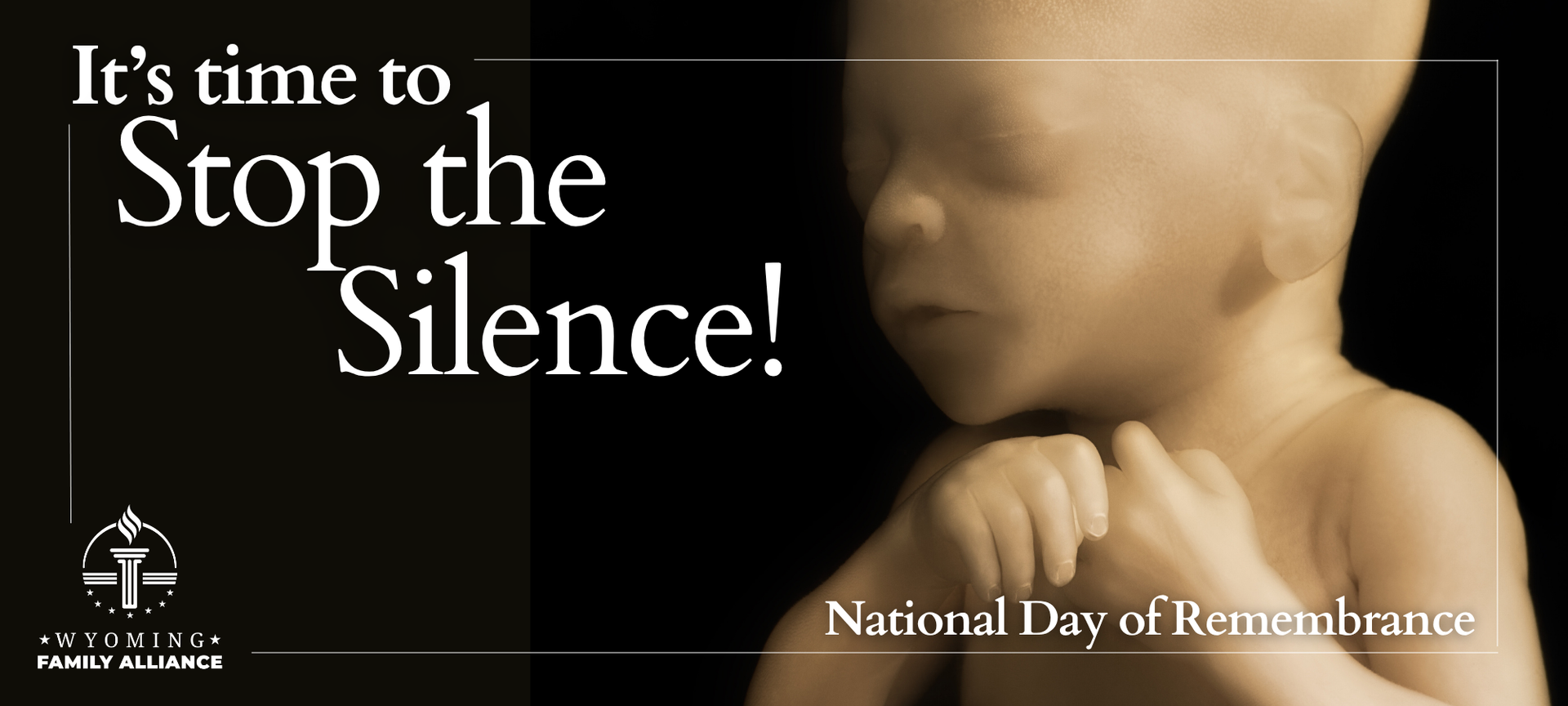
Every year on the National Day of Remembrance for Aborted Children, Wyoming Family Alliance sets aside one minute and four seconds to mourn. This year’s video updates the count to more than 65 million children lost since 1973. If you have watched it and want to know where the numbers come from, or you are facing a pregnancy and need help today, this page is for you.

Need help right now?

Pregnant and need someone to talk to: call or text Option Line, 24 hours a day, at 1-800-712-4357.

Took the first abortion pill and regret it: call the Abortion Pill Rescue Network, 24 hours a day, at 1-877-558-0333.

Both lines are free and confidential. Wyoming centers are listed further down this page.

The numbers, and where they come from

An estimated 1.126 million children were aborted in the United States in 2025. That figure comes from the Guttmacher Institute, which was founded as the research arm of Planned Parenthood and remains the most-cited source of abortion statistics in the country. A second count, the Society of Family Planning’s #WeCount project, arrived independently at 1,126,760 for the same year. Two organizations that favor legal abortion, counting two different ways, landed within a thousand of each other.

Even that figure is an underestimate. Both counts include only abortions provided by U.S. clinicians, including pills prescribed by telehealth and sent through the mail. Guttmacher’s own report states that its numbers “exclude abortions that are not provided by US clinicians (including those provided through community health networks, international clinics, websites or other means)” and that “these findings represent an underestimate of the total number of abortions nationally.” Pills ordered from overseas sellers, or handed out by underground networks, are never counted.

How large is the uncounted number? Nobody knows for 2025, and we will not pretend otherwise. The only peer-reviewed estimate comes from a 2024 study in the Journal of the American Medical Association , which counted pill shipments from community networks, foreign telehealth groups, and online vendors. It found about 26,000 additional self-managed abortions in just the six months after the Supreme Court overturned Roe v. Wade. That is 2022 data, and some of those channels have since been folded into the official counts. The honest conclusion is that the true total is higher than 1.126 million, by an amount no one has measured.

Chemical abortion is now the majority. Guttmacher reports that medication abortion accounted for 63 percent of all U.S. abortions in 2023, up from 53 percent in 2020. #WeCount reports that 28 percent of all abortions in 2025, more than 300,000, were provided by telehealth, meaning a woman received pills without ever being examined in person.

The silence math. At one minute of silence for each child aborted in 2025, our silence would last 781 days, 22 hours, and 40 minutes. That is more than two years of silence, accumulated in a single year. Divided across the calendar, it is more than 3,000 children every day.

We cite these sources because they are the ones our opponents trust. We are pro-life from the moment of conception, and we believe every human being has a natural right to life.

That conviction does not need inflated numbers. The real ones are enough.

If you are pregnant and need help

You are not alone, and you have more options than you may have been told. Every resource below is free and confidential.

  • Option Line, 24 hours a day: call or text 1-800-712-4357, or chat at optionline.org. Option Line connects you to the nearest pregnancy help center and can talk through parenting, adoption, and what an abortion involves.
  • Standing With You: call or text 1-877-910-0096, or visit standingwithyou.org for a Wyoming-specific list of pregnancy centers, WIC and SNAP offices, housing help, and Safe Haven information.
  • Let Them Live: financial support for women considering abortion because of money. Apply at letthemlive.org/get-help or call (260) 200-3789.
  • National Maternity Housing Coalition: if you need a place to live during and after pregnancy, search maternityhousing.com/find-a-home or call Option Line at 1-800-712-4357.
  • Wyoming 211: dial 2-1-1 or 1-888-425-7138, or text your zip code to 898211, for help with food, housing, utilities, and health care anywhere in the state.

Pregnancy resource centers in Wyoming

These centers offer free pregnancy tests, ultrasounds, counseling, parenting classes, and practical help such as diapers, clothing, and cribs. None of them perform or refer for abortions. Call ahead; hours vary.

Casper
True Care Women’s Resource Center
770 E 2nd St
(307) 215-9684  ·  truecarecasper.org
Cheyenne
LifeChoice Pregnancy Care Center
1001 W 31st St
307-323-2655  ·  lifechoicepcc.org
Cody
Serenity Pregnancy Resource Center
1826 Stampede Ave
(307) 213-5025  ·  serenityprc.org
Gillette
Women’s Resource Center of Northeast Wyoming
706 W 8th St
307-685-2211 (call or text)  ·  wypregnancyhelp.com
Jackson
Compass Women’s Care (formerly Turning Point)
25 S Gros Ventre St
307-522-1784  ·  compasswomenscare.org
Laramie
Heart to Heart Pregnancy Resource Clinic
920 E Sheridan St
307-745-3444 (text 307-336-7936)  ·  laramiepregnancy.com
Powell
Serenity Pregnancy Resource Center
215 S Division St
(307) 271-7166  ·  serenityprc.org
Riverton
Elevation Women’s Healthcare
2420 Watt Ct
307-856-0999  ·  elevationwh.org
Rock Springs
Inside Connection Pregnancy Resource Center
731 C St, Building B
(307) 362-5277  ·  insideconnection.org
Sheridan
Legacy Pregnancy Center
847 Coffeen Ave
307-673-4757 (call or text); appointments 307-672-5768  ·  pregnancysheridan.org
Worland
Worland Prolife (mobile ultrasound van, no fixed office; call for the schedule)
Serves Washakie County and the Big Horn Basin
(888) 967-4543  ·  worlandprolife.org

If your town is not listed, the nearest center above usually serves your county, and its mobile unit may visit your town. You can also call Option Line at 1-800-712-4357 and they will find the nearest center, or search the Heartbeat International directory.

If you have taken the first abortion pill and regret it

It may not be too late. The first pill, mifepristone, works by blocking progesterone, the hormone that sustains a pregnancy. Abortion Pill Reversal is a prescription of progesterone, started as soon as possible after the first pill and ideally within 24 hours, that works to counter that block. It does not work every time, and no one can promise an outcome, but the Abortion Pill Rescue Network reports more than 8,000 lives saved since it began.

Abortion Pill Rescue Network

Call 1-877-558-0333, 24 hours a day, or visit abortionpillreversal.com. A nurse will connect you with a provider near you.

Several Wyoming centers listed above, including True Care in Casper and Inside Connection in Rock Springs, participate in the network.

What the abortion pill is

“The abortion pill” is two drugs. Mifepristone blocks progesterone and ends the pregnancy; misoprostol, taken 24 to 48 hours later, causes contractions that expel the baby. The FDA approves the regimen through 10 weeks of pregnancy.

The FDA’s own label reports what women in the clinical trials experienced: between 2.9 and 4.6 percent went to an emergency room, up to 0.6 percent were hospitalized, up to 0.5 percent needed a blood transfusion, and 2 to 7 percent needed surgery to complete the abortion. About 85 percent reported at least one adverse reaction, most commonly bleeding, cramping, and nausea. The FDA has recorded 36 deaths of U.S. women associated with mifepristone through December 31, 2024, while noting that not every death can be causally attributed to the drug.

A 2025 analysis of insurance claims by the Ethics and Public Policy Center, covering 865,727 mifepristone abortions from 2017 through 2023, found that 10.93 percent of women experienced a serious adverse event within 45 days. That study was not peer-reviewed and was published by a conservative think tank, so we present it as what it is: the largest set of real-world records anyone has examined, with a conclusion that deserves the scrutiny it is now receiving. The FDA is conducting its own safety review of mifepristone, and that review is still under way.

Since January 2023, the FDA has allowed the pills to be prescribed by telehealth and mailed, with no in-person exam. A woman can receive them without anyone confirming how far along she is or ruling out an ectopic pregnancy, which mifepristone does not treat and which can be fatal if missed.

After an abortion

Grief after abortion is real, and it is not a sign of weakness. Help is available for women and for men.

What you can do

One minute of silence for a baby killed in the womb is one minute too many.

The way we vote, engage the culture, and live should proclaim that we refuse to accept a future that keeps adding to the count.

  • Follow Wyoming’s pro-life legislation on our Bill Tracker.
  • Find and contact your legislators with My Officials Lookup.
  • Support a pregnancy resource center near you. They run on donations and volunteers, and they are the front line.

GIVE TO WYOMING FAMILY ALLIANCE

Your gift keeps this work going in Wyoming.


Sources

  1. Guttmacher Institute, “Guttmacher Releases Full-Year 2025 Abortion Incidence and Travel Data,” March 2026. Link
  2. Society of Family Planning, #WeCount Report, April 2022 to December 2025, June 2026. Link
  3. Aiken, Wells, Gomperts, and Scott, “Provision of Medications for Self-Managed Abortion Before and After the Dobbs v Jackson Women’s Health Organization Decision,” JAMA, March 2024. Link
  4. Guttmacher Institute, “Medication Abortions Accounted for 63% of All US Abortions in 2023,” March 2024. Link
  5. U.S. Food and Drug Administration, Mifeprex prescribing information, 2023. Link
  6. U.S. Food and Drug Administration, Mifepristone U.S. Post-Marketing Adverse Events Summary through 12/31/2024. Link
  7. U.S. Food and Drug Administration, Questions and Answers on Mifepristone, updated April 2026. Link
  8. Hall and Anderson, “The Abortion Pill Harms Women,” Ethics and Public Policy Center, April 2025. Link
  9. Heartbeat International, Abortion Pill Rescue Network. Link
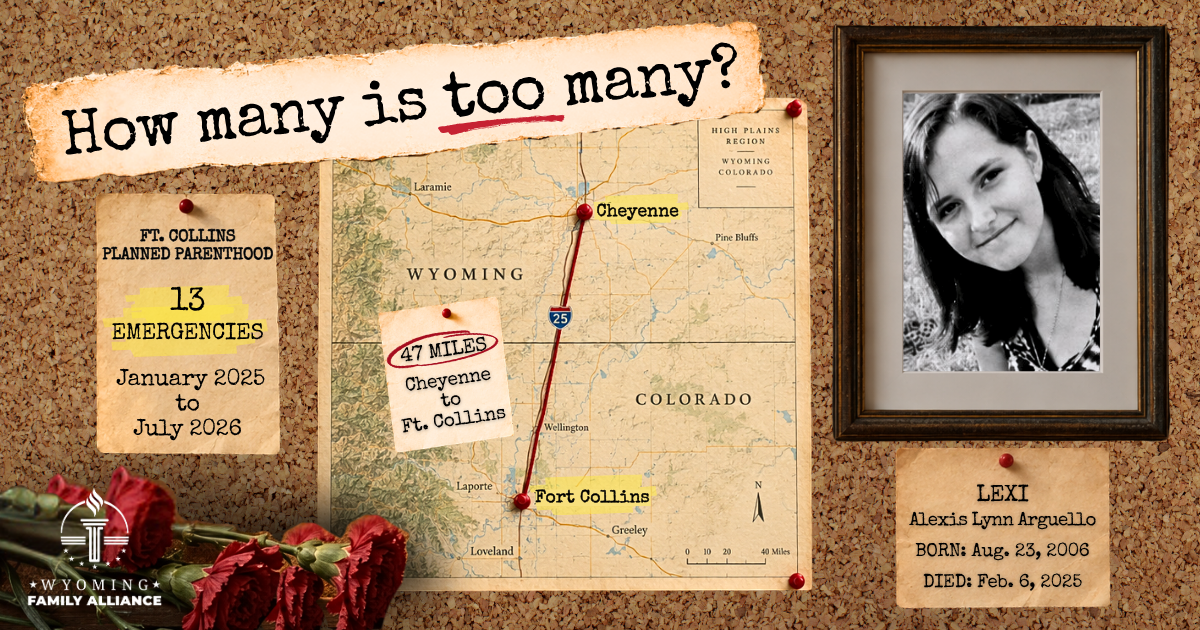
Map showing the 47 miles between Cheyenne, Wyoming and the Fort Collins Planned Parenthood, beside a photo of Lexi Arguello.
September 20, 2026
Eighteen-year-old Lexi Arguello died after an abortion at the Planned Parenthood 47 miles from Cheyenne. Colorado law does not require anyone to inspect it.
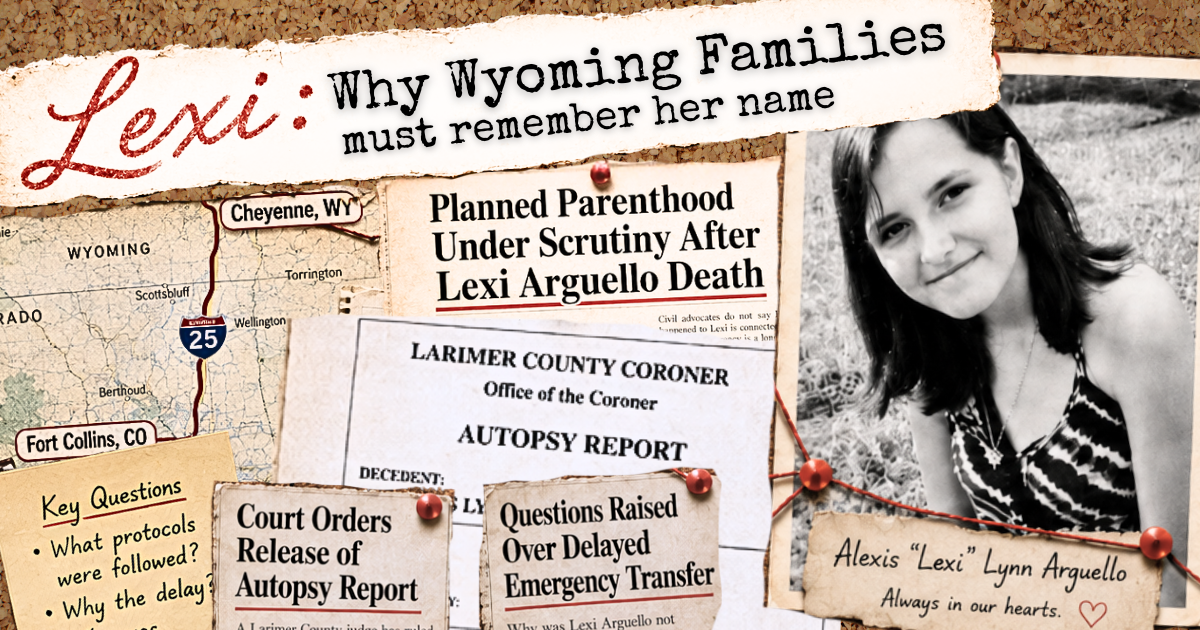
Cork board with a map of Wyoming and Colorado, clippings about Lexi Arguello, and her photograph.
June 7, 2026
Lexi Arguello was eighteen when she died after an abortion at the Planned Parenthood 47 miles from Cheyenne. It took a court order before anyone learned why.
August 21, 2025
5 Ways Wyoming Can Reform Teacher Education With so many aspects of Wyoming’s education system needing reform, the scope of challenges can feel overwhelming. However, one strategic place to begin is at the root: the University of Wyoming’s College of Education. By strengthening the foundation of teacher preparation programs, we can cultivate more well-rounded, knowledgeable, and competent educators, setting the stage for lasting improvements in K–12 student success. Educators who are deeply grounded in core disciplines like math, science, English, and history shape the trajectory of entire communities. When teachers are well-prepared, they help ensure that future generations of Wyomingites—from ranchers and farmers to doctors and lawyers—have the skills needed to navigate life with confidence and competence. By investing in teacher training at the University of Wyoming, we lessen the pressure on local school systems to depend exclusively on state standards and bureaucratic mandates to guarantee teacher performance. Effective teachers can deliver meaningful instruction and foster higher academic achievement without being constrained by checklists or excessive testing requirements. The James G. Martin Center for Academic Renewal published the Blueprint for Reform: Teacher Preparation , which highlights these issues within higher education and outlines actionable steps for improvement. By applying these recommendations at the University of Wyoming’s College of Education, we can better prepare future teachers and ultimately strengthen outcomes for K–12 students across the state. Below are five ways Wyoming can reform teacher preparation: 1. Return to the Basics: Build Phonemic Awareness and Phonics Phonemic awareness—the ability to hear, identify, and manipulate sounds in spoken words—is the first step in learning to read. Once children master this skill, they can progress to phonics, where letters and groups of letters are connected to sounds and used to decode words. Together, these skills give children the tools to “crack the code” of written language, laying a strong foundation early in their learning journey. Applying these concepts has been repeatedly proven as one of the most effective methods for learning to read . Unfortunately, many Wyoming students are not benefiting from these proven methods. According to the 2024 National Assessment of Educational Progress (NAEP), literacy rates in the state continue to decline. Thirty-two percent of students read below the basic level—meaning nearly one in three Wyoming students cannot read at grade level. Only 27 percent demonstrate proficiency, and just 9 percent achieve advanced reading skills. These sobering statistics highlight a critical need: educators must be trained to teach reading using proven, research-backed methods —beginning with phonemic awareness and continuing through systematic phonics. By equipping teachers with the skills to build strong literacy foundations, we give students a greater chance at long-term academic success. While Wyoming students score slightly above the national average in English on the NAEP assessment, the difference is small. Nationally, 40 percent of students perform below the basic level of proficiency, and Wyoming’s results are only marginally better. These numbers are daunting, reflecting a nationwide literacy crisis in which our state is far from immune. Language proficiency is the cornerstone of student success. To master subjects like math, science, and social studies, students must first be able to read, write, and comprehend effectively. In the American education system, logic, reasoning, and comprehension are cultivated through English. Without strong literacy skills, students risk falling behind not just in English, but across every area of learning. One factor contributing to Wyoming’s literacy challenges may be the inconsistent or insufficient emphasis on teaching phonemic awareness in our schools. The National Council on Teacher Quality (NCTQ) reviewed the University of Wyoming’s teacher preparation programs and found that, while four of the five core components of the science of reading are covered, phonemic awareness—the ability to hear and manipulate sounds in spoken words—is not addressed adequately. This omission is critical, since phonemic awareness is a foundational skill for early reading success. Some attribute the gap to the growing burden of state-mandated standards and regulations. With so much content, compliance, and assessment to manage, essential instructional skills—like phonemic awareness and phonics—are too often sidelined. The result is that new teachers enter classrooms less prepared to help students master reading. To reverse this trend, the University of Wyoming should take proactive steps to reintegrate phonemic awareness into its curriculum. This would include offering a dedicated course in the science of reading and ensuring that all elementary education teacher candidates are equipped with the tools they need to teach reading effectively from day one. By doing so, Wyoming can strengthen early reading outcomes and reduce the long-term costs of remediation in its schools. 2. Strengthen Core Content Knowledge Strengthening reading instruction is the first step, but it cannot stand alone. Teachers must also have a solid grounding in core academic subjects to help students connect what they read to the broader world. Without strong content knowledge, even the best literacy instruction falls short. Another NCTQ report highlights gaps in the University of Wyoming’s undergraduate teacher preparation program, particularly in the core content knowledge required of candidates. The review found that essential subject areas—such as Economic Principles and Exchange, The Economy, and U.S. History: 20th Century and Beyond—are not adequately covered. To prepare well-rounded educators, teacher training must extend beyond English, math, and science. Subjects like history, geography, and economics are equally important in shaping informed citizens and effective teachers. The University of Wyoming should require coursework in modern U.S. history and ensure stronger grounding in economics for its elementary education teacher candidates. 3. Depoliticize Teacher Preparation Teacher education programs should eliminate politicized curriculum requirements—such as DEI-focused programming—that can divert attention from student-centered, evidence-based instruction. Wyoming is already moving away from DEI policies, and the University of Wyoming has an opportunity to align with this shift. Concerns remain that DEI and Critical Race Theory concepts continue to influence faculty perspectives and course content at the University. To ensure Wyoming’s teachers are unbiased and focused on academic fundamentals, a re-evaluation of current teaching approaches at the University of Wyoming is warranted. Research—including the James G. Martin Center’s comprehensive report on the politicization of education schools —shows that ideological content can narrow the focus of teacher preparation and undermine academic rigor. With the passage of HB 0147 , which prohibits DEI programs and institutional discrimination in Wyoming’s public institutions effective July 1, 2025, the University should respond proactively. A comprehensive content audit—conducted in partnership with the Wyoming Department of Education—would help ensure that teacher preparation aligns with the state’s standards and expectations for elementary education. While individual beliefs cannot—and should not—be dictated, institutional policies can be refined to keep teacher preparation centered on academic excellence, rather than on ideological trends. 4. Expand Teacher Pathways The Praxis II examination , currently required for teacher licensure in Wyoming, does not measure mastery of the profession, but rather a minimum competency in teaching subjects. Wyoming should consider new pathways into teaching, including alternative licensure programs—or perhaps even, as some legislators have proposed, eliminating licensure altogether. Alternative certification offers practical options. States like Florida and Michigan administer their own teacher certification exams, and the American Board provides an online pathway that has been adopted in 15 states. These models demonstrate that strong alternatives exist beyond the Praxis system. In the 2025 legislative session, Wyoming lawmakers considered HB0100 , which would allow school districts and charter schools to employ teachers without a state-issued certificate or permit, provided candidates pass a background check and meet locally established hiring policies. The bill placed full discretion in the hands of districts, without requiring a degree in education—or even a degree at all—so long as candidates could demonstrate sufficient knowledge or experience in the subject area they were hired to teach. If Wyoming reconsiders this approach, it could significantly expand the pool of capable teachers, particularly in rural areas, and encourage districts to operate in a more free-market environment. By competing for strong educators, school systems would gain flexibility to hire the best talent available, helping to revitalize Wyoming’s education system. 5. Strengthen Accountability The University of Wyoming’s College of Education must be held to higher standards in how it prepares future teachers. To foster meaningful change, accountability should include mandated coursework in areas such as economics, history, and the science of reading. Regular evaluations by the University’s Board of Trustees—reviewing programs and course syllabi—would help ensure alignment with best practices in literacy instruction and core content knowledge. Additionally, separating teacher preparation coursework from the broader undergraduate degree requirements could allow for a more focused, effective training experience. As members of the Great Wyoming Family, we have a duty to steward our communities and our future well. Providing the best education to our children requires giving the best preparation to our educators. Whatever paths our students pursue as adults, they should be able to rely on the strength of a solid education—and we must ensure they receive it.
Show More
Map showing the 47 miles between Cheyenne, Wyoming and the Fort Collins Planned Parenthood, beside a photo of Lexi Arguello.
September 20, 2026
Eighteen-year-old Lexi Arguello died after an abortion at the Planned Parenthood 47 miles from Cheyenne. Colorado law does not require anyone to inspect it.

Sunlit preschool classroom with colorful chairs, tables, toys, and storage shelves
By STATUS: Governor Signed HEA No. 0052 Into Law June 29, 2026
Understand Wyoming's SF0088 law restricting sex offenders from living near child care facilities. Stay informed on child protection efforts.

Hands typing on a laptop on a bed, with a bright screen and yellow sleeves visible.
By STATUS: House Speaker Signed SEA No. 0055 June 29, 2026
Learn about the RAVEN Act (SF0085) aimed at enhancing child protection against internet crimes. Get involved with Wyoming Family Alliance.
Show More

Share this article