Life
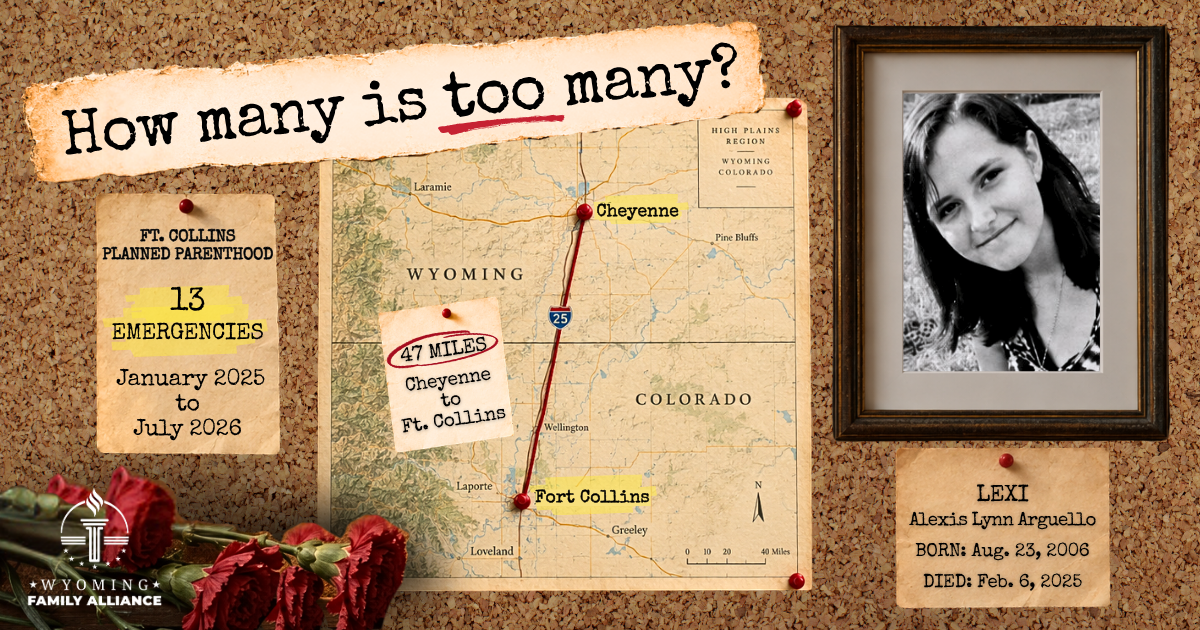
Thirteen ambulances have left Cheyenne’s nearest abortion facility since January 2025. One carried an eighteen-year-old who did not survive. Unlike nail salons, facility inspections are not required.
By Krista Riester
Pro-Life Liaison, Wyoming Family Alliance
Every claim in this article is sourced. Twelve sources are listed at the end.
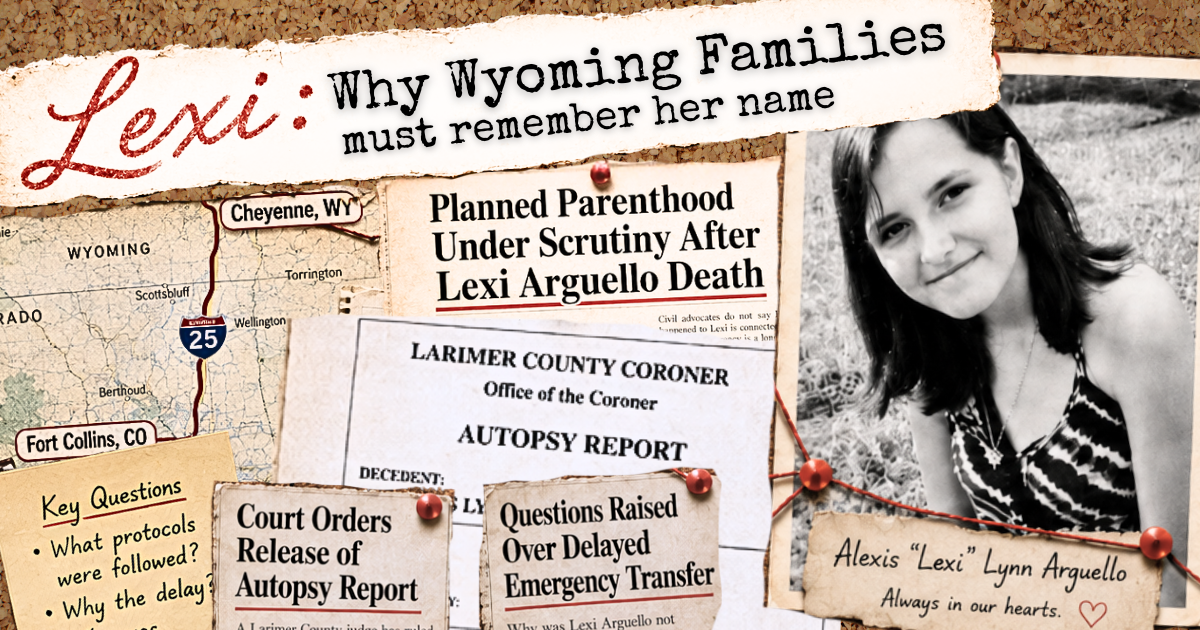
Krista’s first article on this story: Lexi: Why Wyoming Families Must Remember Her Name
It is one thing to drive past a Planned Parenthood. It is another thing to stand in front of one.
Just driving past is enough to make my stomach drop knowing what is happening behind those doors. My heart aches for the men and women walking in, because whether they go in shouting their abortion, in tears, or somewhere in between, something life-changing is occurring. They will come out without the baby they brought in. It sounds like the beginning of a campfire horror story. Babies go in, but they never come out.
But on the morning of August 28, as I stood outside the Planned Parenthood at 825 S. Shields Street in Fort Collins, I felt something darker and more solemn in my spirit. It was my first time participating in anything resembling a protest outside an abortion facility, but I knew it was important for me to be there.
She Never Walked Out
Eighteen-year-old Alexis “Lexi” Arguello entered that same building on February 6, 2025, for an abortion. She was 21 weeks and 6 days pregnant. After the procedure, she was taken by ambulance to the hospital, where she died. The court-embattled, unredacted autopsy concluded that she died from complications of the surgical termination of her pregnancy, including disseminated intravascular coagulation, with probable amniotic fluid embolism, refractory shock, and multiorgan failure listed as significant contributing conditions.
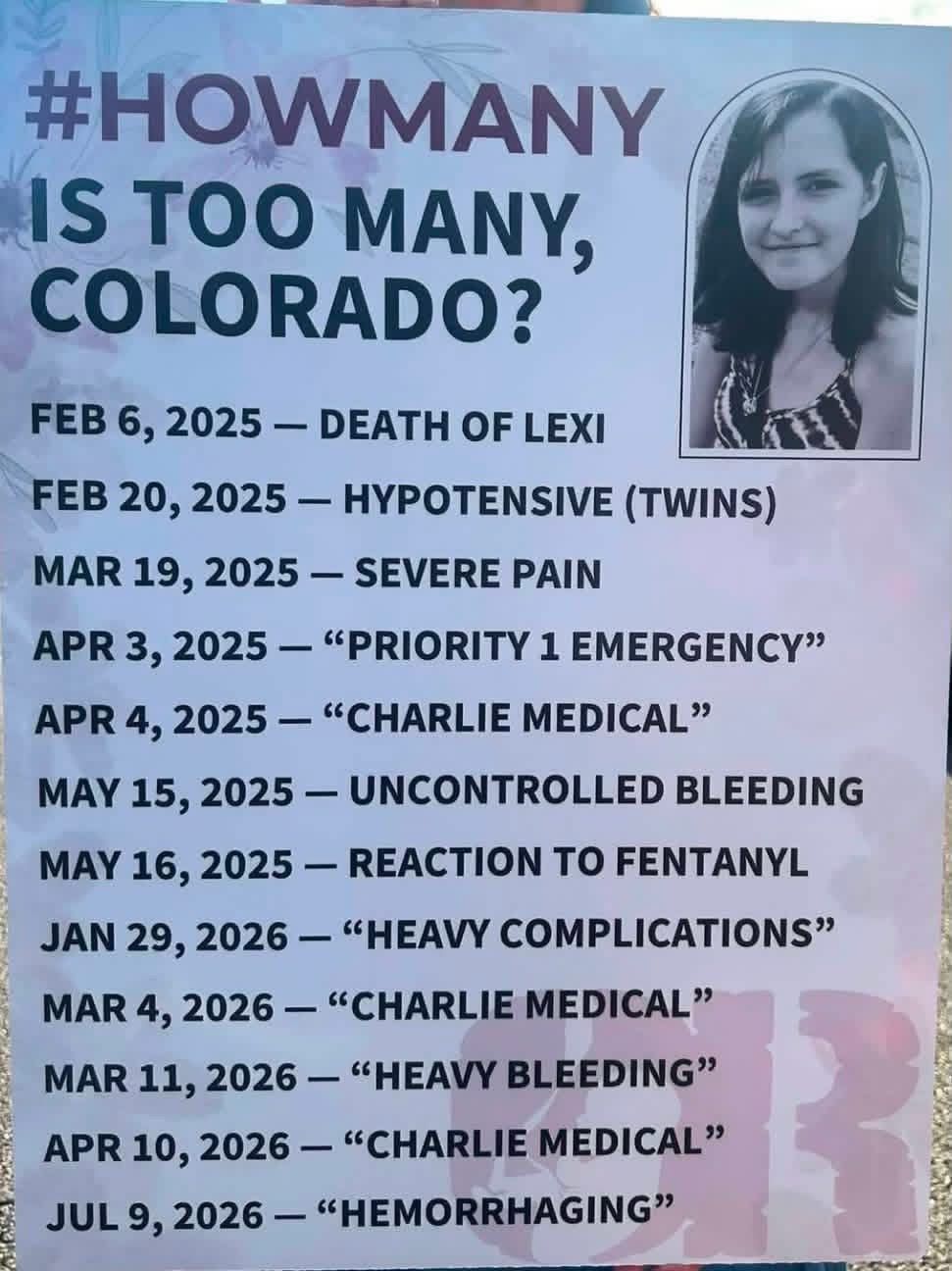
Lexi’s death was the beginning of increased pro-life scrutiny surrounding this facility. Since January 2025, Operation Rescue has documented at least twelve additional women injured at the Fort Collins Planned Parenthood. The incidents include emergency calls involving hemorrhage, heavy bleeding, and other potentially serious complications.
I was joined by Life Legal Defense Foundation, Operation Rescue, Justice For All, Pro-Life Colorado, the American Association of Pro-Life Obstetricians and Gynecologists, and others. People came from across the country for justice, to say that enough is enough, and to ask a simple question:
How many is too many, Colorado?
Silence on the Sidewalk, Shouting From the Cars
In theory, pro-abortion advocates could’ve been there too, joining us in sounding the alarm that some women are not walking out of the Fort Collins Planned Parenthood but instead are leaving by ambulance. But in practice, judging by the onslaught of one-finger salutes and profanity pouring from passing cars, such solidarity was unreasonable to hope for. When ideology overrides introspection, you have the situation I found myself in that hot summer day.
We were mostly silent, holding signs and trying to bring attention to Lexi and the women who have required emergency care since her death. Yet car after car passed with people shouting at us as though demanding accountability for injured women was somehow hateful.
At least one woman walked into Planned Parenthood while we were there, and I stopped to pray.
Many of the people around me were old hands at this, including local volunteers who spend time on that sidewalk regularly. They weren’t fazed by the security guards circling the building. When rap music began blaring from The Marmot next door, one woman barely reacted.
“They do this every time we’re out here,” she told me. “The bar hates us.” In the past this bar has even offered Planned Parenthood Porter and Plan B Pale Ale on tap.
All their anger was directed at the wrong people. The group standing on a sidewalk with the picture of a dead eighteen-year-old girl was not to blame. But it’s too much for some to look in the mirror and admit that they’re supporting a system that is victimizing the very people it claims to champion. I want to believe that if they had just read our signs and learned what happened to Lexi, hearts and minds would change. I want to believe that while significant differences may persist on the value and dignity of the preborn, we could link arms for the safety of women.
The Pro-Woman Test
For decades, the abortion movement has claimed the label “pro-woman.” But it’s clear that the abortion industry is more concerned with taking more cultural ground and self-preservation than the welfare of those it “serves.”
Who is being pro-woman when women are leaving an abortion facility in ambulances? Who is asking what happened to them? Who is asking whether the facility was prepared for those emergencies, whether protocols were followed, whether equipment and staffing were adequate, and whether something could be done differently before another ambulance is called? Who is being pro-Lexi?
Who is being pro-Lexi?
On that sidewalk, the answer seemed remarkably clear. There was one group of people demanding answers, and they were the pro-lifers. Knowing that abortion is a sacred cow in Colorado, it probably doesn’t surprise you to hear that none of these heartbreaking cases, including Lexi’s death, have resulted in a state inspection of the facility or its processes, let alone any consequences.
Dr. Catherine Wheeler, a former abortionist and now head of AAPLOG Colorado, pointed out in the coalition’s press release for the event that national survey data puts hospital transfers from ambulatory surgical centers at roughly 1.1 per 1,000 procedures. We cannot calculate the comparable rate for the Fort Collins Planned Parenthood because we do not have transparent facility-level procedure and complication data. But thirteen documented emergencies at one facility are more than enough to justify asking the questions Colorado’s regulatory structure currently does not require anyone to answer.
The List Abortion Clinics Are Not On
The Colorado Department of Public Health and Environment licenses, inspects, and sets standards for a long list of facilities: hospitals, freestanding emergency departments, ambulatory surgical centers, dialysis clinics, birthing centers, nursing care facilities, hospice care, assisted living residences, community clinics, and home care agencies. Licensed facilities are required to undergo both announced and unannounced inspections.
In 2025, just weeks after Lexi’s death, a bill was proposed to require annual licensing and standards for facilities performing second- and third-trimester abortions. It was defeated along party lines in committee. In 2026, legislators tried again with the same outcome.
To be precise, this does not mean abortionists themselves operate without professional licenses or that no government entity can ever investigate an individual practitioner. In fact, after Operation Rescue filed a complaint concerning Lexi’s death, the Colorado Department of Regulatory Agencies opened an investigation into the licensed practitioners involved. I have found no public indication that the investigation resulted in any action. What Colorado lacks is the separate CDPHE facility-licensing and inspection structure applied to numerous other health-care facilities.
That distinction matters, because a medical professional’s license and the safety of an entire facility are not the same question.
The Nail Salon Standard
I recently heard someone put the absurdity in much simpler terms: Should your nail salon be subject to more government oversight than an abortion facility?
In Colorado, nail salons must register with the state. Nail technicians must be licensed. The state has sanitation and disinfection requirements, and inspectors are authorized to examine the entire premises, including workstations, closets, drawers, and storage areas.
Apparently, asking for comparable facility oversight for someone giving you a manicure and someone entering a woman’s uterus is controversial.
If Abortion Is Healthcare, Regulate It Like Healthcare
Abortion advocates insist that abortion is healthcare, not politics. Let’s follow that argument to its logical conclusion.
Healthcare has standards and accountability. Healthcare investigates adverse outcomes because the goal is not merely to preserve access to a procedure, but to protect the patient undergoing it. Healthcare codifies regulation and transparency.
You do not have to agree with me that Lexi’s nearly 22-week-old child deserved protection to believe Lexi did. You do not have to oppose abortion to want to know why women repeatedly require emergency transport from the same facility. You do not have to become pro-life to think an abortion facility performing late-term procedures should be subject to meaningful health and safety oversight.
Colorado has arrived at the point where it needs to choose between the interests of an abortion provider and the interests of the women, because these paths have clearly diverged.
Ten Minutes to Campus
I then left the building where an eighteen-year-old underwent the abortion that caused her death and drove less than ten minutes to a campus full of eighteen to twenty-two-year-old women. Women who would have been Lexi’s classmates.
We tabled at Colorado State University with a poll: Should abortion be legal?
What surprised me wasn’t that the pro-life position wasn’t even remotely close to being evenly represented by the students who stopped by to talk. It was the contrast between the behavior of those driving by on Shields and the students we talked with.
They disagreed with us, some more strongly than others, but they talked to us. They voted in our poll. They listened. We listened. For the most part, they managed something many of the adults driving past Planned Parenthood had not: disagreement with civility.
They managed something many of the adults driving past Planned Parenthood had not: disagreement with civility.
Kudos to them for that. There is hope for respectful dialogue about abortion yet, and that’s a big part of how we move the needle in the culture.
And we need these discussions now more than ever in Colorado and its neighboring states, because the abortion frontline is moving to the campus.
In May, Gov. Jared Polis signed HB26-1335, which states that effective August 1, 2027, Colorado institutions of higher education that operate student health centers will be required to provide students access to abortion pills. Colorado is actively expanding abortion access on college campuses while the gap in facility oversight for surgical abortion providers remains unresolved.
It’s back-to-school season. Wyoming families just dropped their kids off at CSU and other schools in a state whose legislature has twice rejected bills that would subject facilities like the one where an eighteen-year-old died to CDPHE licensing and inspection, yet will also soon require college health centers to provide students abortion pills.
I would want better for my own daughters than walking into a facility that the state of Colorado does not license, will not inspect, and refuses to hold accountable after thirteen ambulance runs, one ending with a dead teenager.
Your daughters, wives, girlfriends, granddaughters, nieces, and friends will not be told that. There is no requirement to disclose it. There is no inspection report to look up.
Colorado may want to bury Lexi, both figuratively and literally, and then forget. But Colorado’s moral blindness cannot take I-25N to Wyoming.
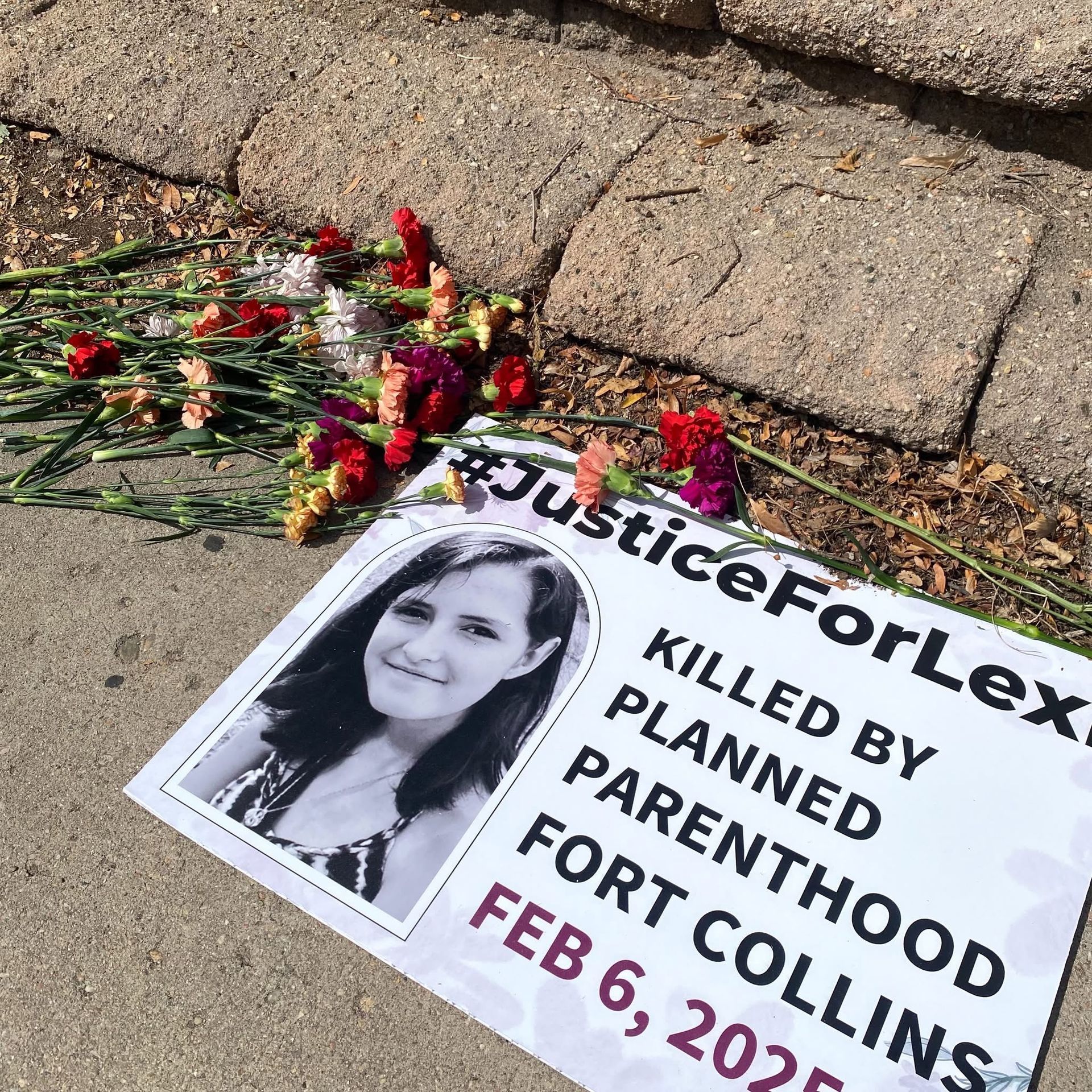
When the rally ended, we laid flowers at the base of the steps leading to the Planned Parenthood. But when I left CSU, I was surprised to see they hadn’t been thrown away yet. Who knows if they hadn’t noticed or had simply forgotten, but I hope and pray that at least one person saw and will choose a different path for herself, knowing that the road that promises autonomy and freedom can be, and sometimes is, lined with memorial flowers.
A Note From Wyoming Family Alliance
Although there is no Planned Parenthood health center anywhere in Wyoming, Planned Parenthood of the Rocky Mountains lists Wyoming as one of the three states it serves, and the Fort Collins clinic is the closest one to Cheyenne. It is 47 miles from the Wyoming Capitol, less than an hour’s drive. Casper, where Wyoming’s only abortion clinic operates, is 178 miles away.
Krista made this point when she first wrote about Lexi in June. In practical terms, she wrote, that facility “functions as the nearest abortion provider for many women in southeastern Wyoming. That makes this our story too.”
Lexi’s death has not produced a single state inspection. It can at least produce more people asking why. Share this article with someone who has a daughter, a sister, or a friend heading to campus this fall.
Sources
Note: several facts about the circumstances surrounding Lexi’s death, the legal challenge for her autopsy, and the failed legislative regulation were cited in the original piece and are not repeated here.
The account of the sidewalk that morning, including the reaction of passing drivers, the music from the neighboring bar, and the conversations at Colorado State University, is firsthand and does not appear in the published record.
Untappd, The Marmot, Planned Parenthood Porter listing
Untappd, Three Four Beer Co., Plan B Pale Ale listing
Wyoming Family Alliance, Krista Riester on Lexi Arguello (June 2026)
Live Action News, another injury reported at a Colorado Planned Parenthood
EWTN News, watchdog group flags safety concerns at Colorado abortion clinics
Christian Newswire, coalition press release for the August 28 campaign
Operation Rescue, recap of the Justice for Lexi campaign
Problems at Planned Parenthood, Colorado incident record
Colorado Department of Public Health and Environment, licensed health facilities
Operation Rescue, Colorado practitioners under investigation
Colorado Secretary of State, 4 CCR 731-1, cosmetology and nail salon rules
Wyoming Family Alliance Action is a trade name of Wyoming Family Alliance, a 501(c)(4) organization and sister ministry of Wyoming Family Alliance Foundation.
Wyoming Family Alliance Foundation is a trade name of Wyoming Family Foundation, a 501(c)(3) organization and sister ministry of Wyoming Family Alliance Action.
Support the Alliance · 501(c)(4)
Support the Foundation · 501(c)(3)