Why the Religious Freedom Restoration Act still matters, in Washington and in Wyoming
By Nathan Winters
President & CEO, Wyoming Family Alliance
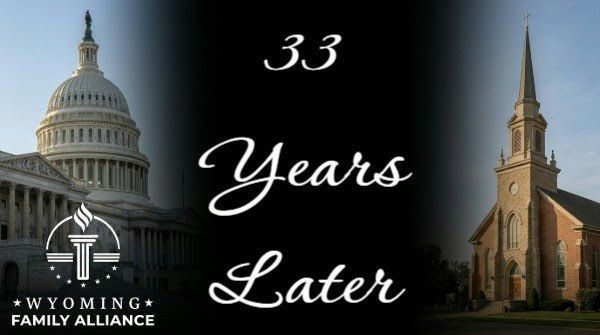
On November 16, 1993, Bill Clinton stood on the South Lawn of the White House and signed a bill that had passed the House without a single dissenting voice and the Senate by a vote of 97 to 3. Chuck Schumer introduced it. Ted Kennedy and Orrin Hatch carried it together. A coalition stretching from Americans United for Separation of Church and State to the National Association of Evangelicals cheered it.
If you are under forty, you may want to read that paragraph twice.
The law was the Religious Freedom Restoration Act, and thirty-three years later it remains one of the most important guardrails we have for what the founders called our first freedom.
Why It Was Needed
RFRA answered an emergency. In Employment Division v. Smith (1990), the Supreme Court ruled that government may burden religious practice so long as the law doing the burdening is "neutral" and "generally applicable." Out of character with his usual good jurisprudence, the much-beloved Justice Scalia admitted this would leave minority faiths at a disadvantage, but he called that an "unavoidable consequence of democratic government."
Americans of nearly every creed found that unacceptable. RFRA restored the older rule: government may substantially burden a person's exercise of religion only if it has a compelling interest and uses the least restrictive means to pursue it. It was carefully designed to ensure that it would not be a license to do everything imaginable in the name of God. It would simply put the burden on the government to prove that they were not infringing on a person’s foundational rights without a truly compelling interest and if they had to infringe, that they were to use the “least restrictive means.”
A square stripped of faith is never truly empty. Something else always moves in.
One Sentence, Two Clauses
The First Amendment opens with a single sentence holding two guarantees: Congress shall make no law "respecting an establishment of religion, or prohibiting the free exercise thereof." The first clause keeps government from running the church. The second keeps government from running your conscience. Both protect religion from the state, not the state from religion.
For half a century, a certain kind of activist has read that sentence as if it stopped at the comma. In 1971, in Lemon vs. Kurtzman, the Establishment Clause was inflated from a shield against a national church into a sword against any visible faith: a nativity scene on the courthouse lawn, a prayer before a football game, a Bible on a teacher's desk. Richard John Neuhaus saw where this led and gave it a name: the naked public square. A square stripped of faith is never truly empty. Something else always moves in.
The Supreme Court has begun to correct course. In Kennedy v. Bremerton (2022) it finally buried the Lemon test that had made so much mischief, and it sided with a coach fired for praying at the fifty-yard line. But court majorities come and go. RFRA gives free exercise a floor that does not depend on who sits on the bench.
What It Has Done
RFRA and its sister statute have protected a small congregation's sacramental tea, a Sikh soldier's turban, a Muslim prisoner's beard, and the Little Sisters of the Poor. When the federal government finds itself in court against nuns who care for the dying poor, it is fair to ask which party has lost its way.
Notice who benefits. Religious liberty is not a Christian privilege. It is a human right, and RFRA has defended Jews, Muslims, Sikhs, Native Americans, Catholics and evangelicals alike. That is precisely why it once enjoyed near-unanimous support.
Ten years is a long time to wait for common sense, but a right cause is worth waiting for.
Wyoming's Turn
In 1997, City of Boerne v. Flores held that RFRA could not bind the states. Each state would have to protect its own citizens.
I first introduced a Religious Freedom Restoration Act in the Wyoming Legislature in 2015, the same year Indiana's version was met with corporate boycotts and celebrity outrage. A law that once passed 97 to 3 was suddenly treated as a bigot's charter. During that session, a twitter feed included over 750,000 people from around the world, attacking anyone who would support this important legislation. While the bill was allowed to die in the Senate that year, the idea did not die. On March 6, 2025, through the hard work of Representative Art Washut, I had the privilege to stand with Governor Mark Gordon as he signed House Bill 207, making Wyoming the 29th state with its own RFRA. Ten years is a long time to wait for common sense, but a right cause is worth waiting for.
The Work Ahead
The Psalmist asks, "If the foundations are destroyed, what can the righteous do?" (Psalm 11:3). The answer is to rebuild them, one statute and one state at a time.
Thirty-three years on, RFRA reminds us that the First Amendment has two clauses, and a free people must defend both. The Establishment Clause was never meant to drive faith from the public square. It was meant to keep government from deciding who may stand there.
Support Our Efforts
You can support us by donating to Wyoming Family Alliance Foundation, our 501(c)(3), or to Wyoming Family Alliance Action, our 501(c)(4). You can also support us as a Prayer Ally, Sponsoring Ally or Sustaining Ally. Visit our website for more information about these opportunities.
SUPPORT WFA
Wyoming Family Alliance Foundation is a trade name of Wyoming Family Foundation, a 501(c)(3) organization and sister ministry of Wyoming Family Alliance Action.
Wyoming Family Alliance Action is a trade name of Wyoming Family Alliance, a 501(c)(4) organization and sister ministry of Wyoming Family Alliance Foundation.
Support the Alliance · 501(c)(4)
Support the Foundation · 501(c)(3)